Your thinking has blind spots. And so does AI.

We live in the era of instant answers. You type a query into ChatGPT, get a paragraph back, and think: done. But have you ever wondered why the response felt so predictable? Why it perfectly validated exactly what you were already thinking?
It’s not a coincidence. It’s a design principle. Most AI systems are optimized to give you the most probable answer. Not the most surprising. Not the most uncomfortable. The most probable. And that is exactly what makes them—despite their brilliance—a mirror of your own cognitive habits.
The Problem: You Always Think the Same Way (And Don't Realize It)
Everyone has thinking patterns. Analytical thinkers ask analytical questions. Emotional thinkers seek emotional answers. That’s normal. But it also means you’re constantly operating within the exact same quadrant of your own mind.
Psychologists call this Confirmation Bias—the tendency to seek out and favor information that confirms your existing worldview. Classic AI chatbots amplify this effect because they are trained to provide helpful, affirming responses. They don’t contradict you. They don’t surprise you. They just give you what you want to hear.
The Result: You keep asking the same kinds of questions, receiving the same kinds of answers, and tricking yourself into believing you’ve learned something new. You haven't. You’ve merely validated your existing mental framework.
What If AI Didn't Just Answer—But Shifted Your Thinking?
This exact question drove the development of neurit.ai. Neurit isn't a chatbot. It’s a thinking tool. Instead of one single answer, you get six different perspectives on the same question—generated through six specialized thinking modes, each forcing a completely different angle.
An example:
You ask: "Why does my team never tell me what they honestly think?"
A standard chatbot feeds you three paragraphs about psychological safety, feedback culture, and open communication. True, but predictable. You essentially just Googled it, only faster.
Neurit does something else:
- Invert flips the premise: "Maybe your team is telling you exactly what they think—just not with words, and you're tuning into the wrong channel."
- Child Mind asks naively: "If you get mad when someone says the wrong thing, why would they ever speak up again?"
- Paradox finds the contradiction: "Honesty within a team requires that the person receiving the truth can actually handle it."
Same question. Three entirely different cognitive directions. None of them are "the ultimate answer." But together, they show you exactly where your mind usually refuses to go.
The Mental Map: Making Your Mind Visible
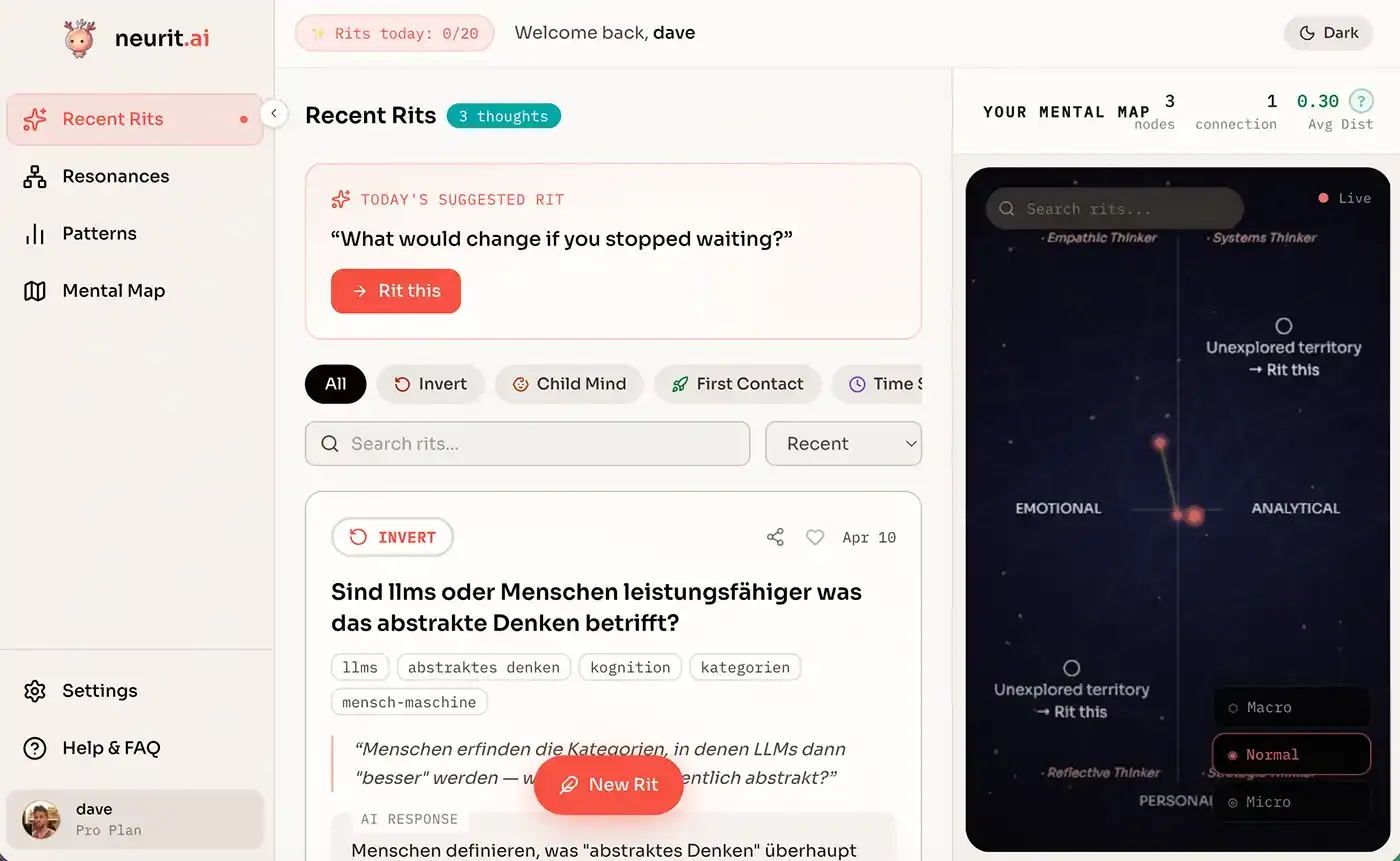
The truly revolutionary part of Neurit isn't the answer. It’s the Mental Map—a visual representation of your thought process that expands with every question you ask.
The Mental Map operates on two axes:
- Horizontal: Emotional ↔ Analytical — How do you think?
- Vertical: Personal ↔ Universal — What do you think about?
This creates four distinct quadrants:
- Empathic Thinker — views the world emotionally
- Systems Thinker — analyzes the world systematically
- Reflective Thinker — processes themselves emotionally
- Strategic Thinker — analyzes their own life strategically
Every question you ask is plotted as a point on this map. After five questions, a pattern emerges. After twenty, you see your profile. And after fifty questions, you discover something no personality test in the world could ever show you: where you never go.
The empty quadrants are your blind spots. Not because you don't understand them, but because it simply never occurs to you to think in that direction.
Six Thinking Modes — Six Different Brains
Neurit operates with six specialized thinking modes. Each mode uniquely transforms your question before the AI even generates a response. This is the crucial difference from a regular chatbot: the AI isn't answering your original question. It’s answering a shifted version of it.
| Mode | What it does | Example |
|---|---|---|
| Invert | Flips the assumption | "What if the exact opposite is true?" |
| Child Mind | Asks naively and directly | "But why is that, really?" |
| First Contact | Observes as an outsider | "Explain this to an alien who has never seen it." |
| Time Shift | Shifts the timeframe | "How would people have viewed this 500 years ago?" |
| Zoom Out | Reveals the macro dimension | "What is the actual context here?" |
| Paradox | Finds the contradiction | "What if both are true at the same time?" |
Three thinking modes (Invert, Child Mind, First Contact) are free to use. The three deeper modes (Time Shift, Zoom Out, Paradox) are included in the Pro Plan.
Who is Neurit For?
Neurit isn't a tool for people looking for quick answers. That's what ChatGPT is for. Neurit is for people who want to think better:
- Founders and Entrepreneurs who need to break out of their own cognitive frameworks to see their product or strategy in a new light.
- Creatives and Writers searching for that spark that doesn't just come from the very first obvious association.
- Teams that want to understand why they keep arriving at the exact same solutions—and what happens when someone from a completely different quadrant looks at the identical problem.
- Curious Minds who want to get to know themselves better. The Mental Map is essentially a mirror that reflects not your face, but the shape of your thoughts.
ChatGPT vs. Neurit: The Difference in 30 Seconds
| ChatGPT | Neurit | |
|---|---|---|
| Goal | Provide the best answer | Shift your thinking |
| Result | A paragraph | Six perspectives |
| Memory | Forgets by tomorrow | Mental Map grows with every query |
| Blind Spots | Confirms them | Reveals them |
| Style | 280 words to say nothing | 60 words that hit the mark |
What Does It Cost?
Neurit relies on a straightforward freemium model:
- Free: 3 Perspective Shifts per day, 3 Thinking Modes, personal Mental Map
- Pro (€14.90/month): 20 Shifts per day, all 6 Thinking Modes, Thinking Insights, and Pattern Reports
- Team (€24.90/Seat/month): Everything in Pro + Challenge Mode, Collision Report, Shared Mental Map
No hidden fees. No forced subscriptions. It only takes one question to feel the difference.
What do you think about — and what do you never think about?
Ask your first question and see what happens when six thinking modes challenge your perspective instead of confirming it.
Try it for free now →

WEBSE-Glossary:
- Rit: A single thought process in Neurit—consisting of your question, the perspective shift, and the AI response. Every Rit is saved as a point on your Mental Map.
- Lateral Shift: The reformulation of your question by one of the six thinking modes. The Shift is the actual core of Neurit—it shifts your perspective before the AI even answers.
- Mental Map: A visual map of your thinking with two axes (Emotional ↔ Analytical, Personal ↔ Universal) and four quadrants. Every question is automatically plotted on the map.
- Blind Spot: A quadrant on your Mental Map that is empty or barely populated. It doesn't show what you don't know, but rather where your mind never wanders.
- Thinking Pattern: An automatically generated snapshot of your thinking style, created every five Rits. It shows trends, dominant quadrants, and surprising connections between your thoughts.
- Resonance: A connection between your thought and the thought of another user. Resonances occur when two people independently ask similar questions—without knowing about each other.
Fragen zu deinem Projekt?
Erzähl uns, woran du arbeitest. Wir schauen es uns an und melden uns.
Projekt besprechen